AI: Boom or Bust Either way we are doomed
The Architecture of a Collapse: Why the AI Bubble is a Macroeconomic Black Hole
Introduction:
AI. These two letters have become more pronounced than "Hello" in the business world because the impact of Artificial Intelligence is going to be irreversible. It has the capability to break the existing economic system—a modern Pandora’s box.
When I think about the implications of AI in the near future, the negatives consistently outweigh the positives. I am generally an optimist, but I cannot view this brewing situation optimally. If this trend prevails without substantive precautions, we might end up in one of two broad scenarios.
I have two pieces of news for you: the first is bad, and the second is worse.
People today are polarized into two broad camps regarding AI's societal impact. One group—the optimists—believes AI is the next revolution, a savior that will rescue humanity from the rat race and redundant jobs. The other group—the rationalists—fears this might be a massive bubble, with the capability to inflict damage worse than the 2008 crisis.
The Pessimist View: The Bad News
Before diving into the fallout, we must understand how the existing capital system works to grasp the rationalist theory.
The modern market economy glorifies aggressive expansion over stability. Symbolically, you can look at the 1973 detachment of the US Dollar from the gold standard as the beginning of this era. Focusing on rapid credit expansion, this system relies heavily on two major tools:
- Fractional Reserve Banking (The Money Multiplier): Approximately 90% of circulating money is created out of thin air, legitimized entirely by trust in the government.
- Leverage Investment: Capitalizing investments using credit, anticipating high rewards.
As you can infer, the current system was designed to be fragile, favoring vast financial expansion over solid footing. To understand the danger of the current AI bubble, we must compare it to two historical economic events.
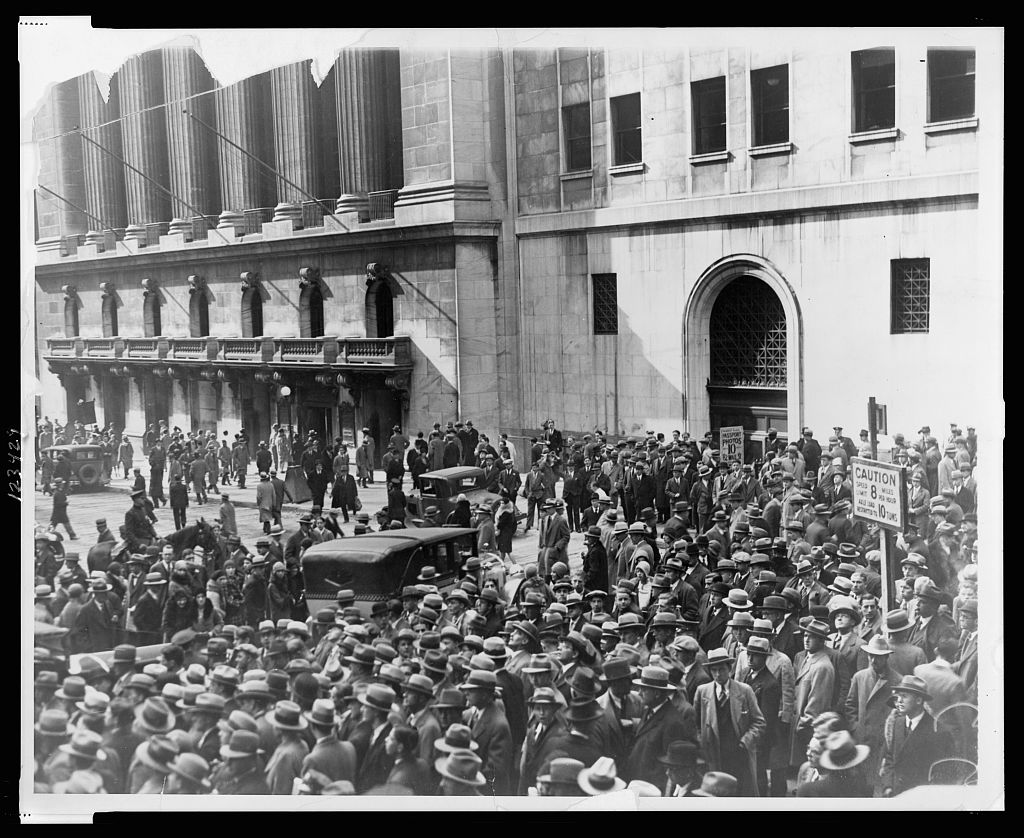 Crowd outside the New York Stock Exchange following the Crash of 1929. Public Domain via Library of Congress.
1. The 1929 Wall Street Crash
- The Bubble Volume: At the peak in September 1929, the total market capitalization of the New York Stock Exchange was roughly $90 billion—almost equal to the entire US Gross National Product (GNP) at the time.
- The Government Condition: The US government was in pristine financial health. The national debt was only $16.9 billion, meaning the Debt-to-GDP ratio was just 16.5%.
- The Result: The government had infinite room to intervene, but due to a commitment to balanced budgets, they chose not to inject liquidity. The market collapsed by 89% over three years, triggering the Great Depression.
2. The 2008 Great Financial Crisis
- The Bubble Volume: The core of the 2008 crisis was the housing market. By the peak, US home mortgage debt had bloated to $10.5 trillion (roughly 73% of GDP). When the bubble burst, US household wealth plummeted by $11 trillion.
- The Government Condition: By 2008, the US government balance sheet was heavier but still manageable. The total Debt-to-GDP ratio was roughly 68%.
- The Result: Because the government still had fiscal runway, they could absorb the toxic assets. Central banks executed the largest monetary policy action in history, purchasing over $2.5 trillion in troubled assets to save the capitalist system.
3. The Current AI Boom (2024–2026)
- The Bubble Volume (CapEx): We are looking at unprecedented private capital allocation. Big Tech is projected to spend over $405 billion on AI Capital Expenditure (data centers, GPUs) in 2025 alone. Across a three-year window, they will have sunk nearly $800 billion into AI infrastructure. Analysts project the total cost of AI data centers will require between $3 trillion to $8 trillion by 2030. This is capital being burned with currently negligible revenue returns.
- The Government Condition: Today, the US National Debt is approaching $39 trillion. The Debt-to-GDP ratio is currently over 120%.
By comparing the current fiscal conditions of global governments against historical crises, the intensity of this danger becomes mathematical reality.
The Optimist's Ideal World: The Worse News
The second scenario—the "optimistic" view where the AI bubble succeeds and delivers on its promises—is paradoxically the more catastrophic outcome. Let me explain this using a simple skyscraper model.
Consider the micro-economy of a single tech skyscraper. If AI successfully automates the coding jobs within those walls, the destruction does not end at the lobby. Urban economics dictates a massive Local Multiplier Effect; for every high-paying tech job, five secondary service jobs are sustained—from the cafeteria workers and transit operators to local real estate valuations. When the primary wage earner is automated, the disposable income feeding this localized service ecosystem evaporates. The secondary shockwave will be infinitely more destructive than the initial tech layoffs.
Now, apply inductive reasoning and scale this globally. Advanced economies do not manufacture goods; they provide services. The service sector accounts for nearly 80% of the GDP in developed nations. If the first wave of AI wipes out the cognitive elite in IT, the ensuing waves will rapidly commoditize teaching, legal analysis, and administration.
We are not just facing structural unemployment; we are facing a fundamental shift in the means of production. Wealth will hyper-concentrate into the hands of the few entities that own the AI infrastructure, reducing the remaining population to redundant, low-value maintenance roles.
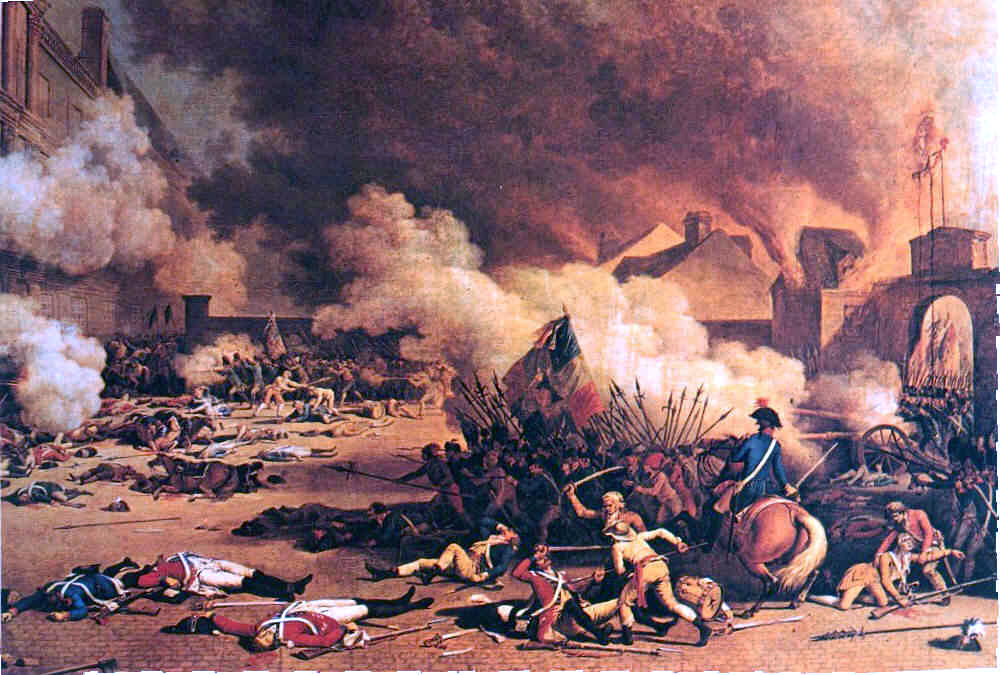
History is deeply unforgiving to societies that strip the working class of their utility and dignity. We do not need to look to Karl Marx to understand the endgame of total wealth stratification; we only need to look at the French Revolution.
The Storming of the Tuileries Palace, August 10, 1792. Public Domain via Wikimedia Commons.
When a population realizes they have been permanently priced out of providing economic value and have nothing left to lose, civil decorum shatters. The ultimate threat of a successful AI boom is not a Terminator scenario; it is a rapid descent into techno-feudalism, followed inevitably by violent social upheaval.
Conclusion: The Runaway Train
One might hope that the architects of this technology would recognize the precipice we are approaching, but that is a naive misreading of modern incentive structures.
We cannot rely on the moral compass of Silicon Valley. From Nadella to Altman, these executives are bound by the absolute capitalist mandate of fiduciary duty; they are legally and financially incentivized to feed the bubble, regardless of societal externalities. Asking them to self-regulate is like asking a locomotive to lay its own tracks while running at full speed.
Furthermore, the escalating technological decoupling between the United States and China guarantees that neither superpower will unilaterally hit the brakes. To pause AI development for the sake of domestic societal stability is to willingly surrender global hegemony to a foreign adversary.
Therefore, the machine will not stop. The capital will continue to flow, the data centers will continue to rise, and the leverage will continue to stack. Whether this era ends in a devastating macroeconomic credit collapse, or succeeds only to usher in violently stratified techno-feudalism, one reality remains absolute:
The current system has no brakes, and we are accelerating towards the wall.