Why you must choose your Sacrifice before it chooses you
Why you must Choose your sacrifice before it chooses you.
Introduction The greatest triumph of the modern, democratic, capitalist world is the absolute abundance of choice. However, this virtue has rapidly mutated into a curse. We have engineered a cultural myth: the belief that you can acquire anything you desire with the simple swipe of a card, bypassing the required suffering.
We are witnessing a generation hypnotized by the aesthetic of success, entirely divorced from the architecture of sacrifice required to build it. When confronted with the reality that the universe demands a toll, they feel as though the world is ending. They demand the reward, yet actively refuse to pay the opportunity cost of the grind.
The Differentiator: Winners vs. Dreamers The entrepreneur Alex Hormozi famously stated, "Sacrifice and suffering is inevitable, so choose the right thing to suffer."
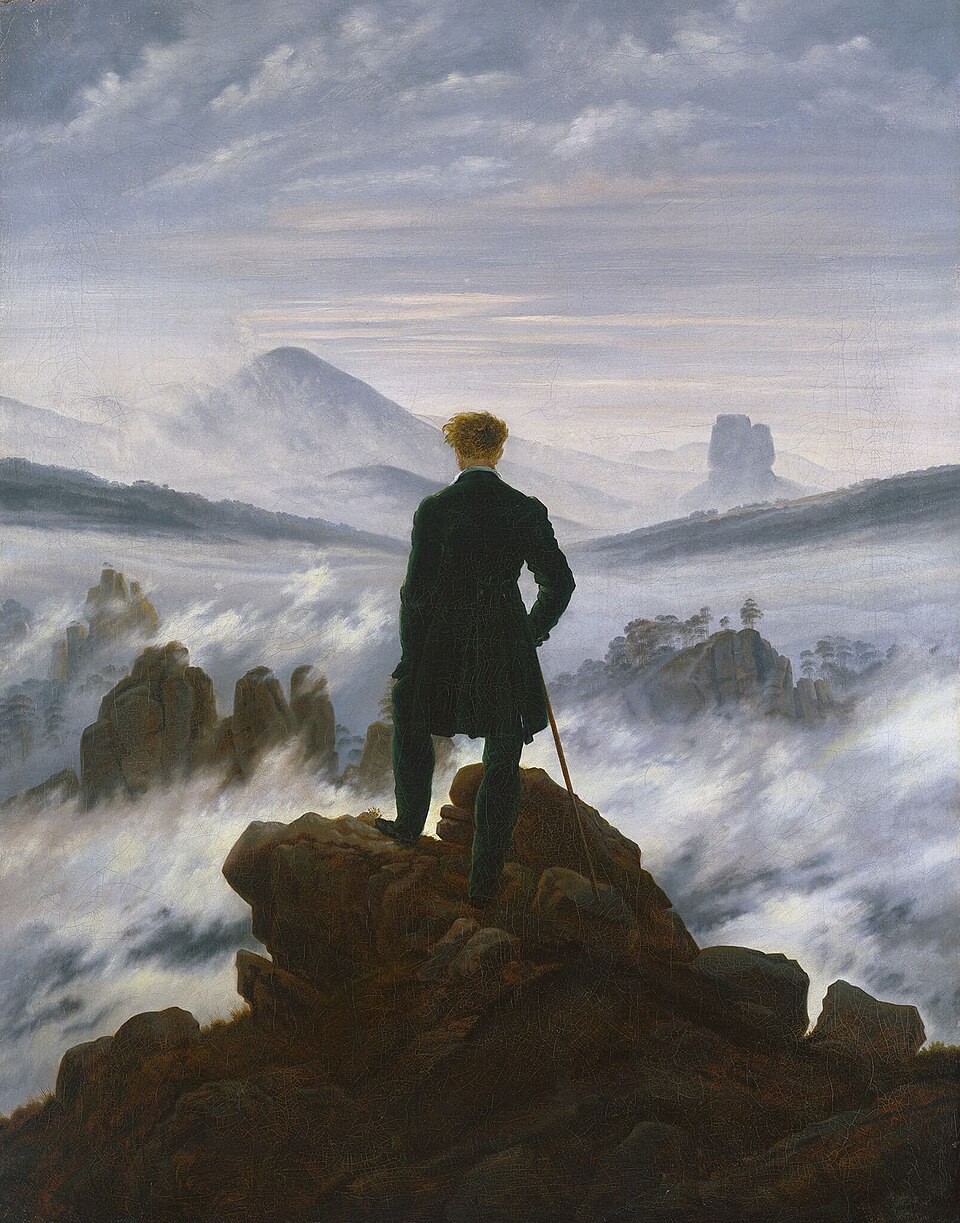
!Wanderer Caspar David Friedrich: Wanderer above the Sea of Fog
This is the dividing line between those who build empires and those who merely dream of them. Society overemphasizes the downside risk of failure—the paralyzing fear of ending up on the street if you make the wrong choice. In reality, the floor for failure in the modern world is relatively high; even if a massive risk fails, you will likely still survive.
The true danger is not making the wrong choice; it is making no choice out of the fear of leaving something on the table. Choosing to endure one specific suffering, while deliberately abandoning all other options, is the most mathematically optimal solution for success.
The Invisible Tax of "Doing Nothing" In classical economics, opportunity cost is defined simply as the potential benefit lost when you choose one alternative over another. If a government spends ten billion dollars on temporary welfare subsidies, the opportunity cost is the next-generation semiconductor infrastructure they can no longer afford to build.
Most people understand this conceptually. Yet, when applied to their own lives, they go completely blind. We suffer from the illusion that indecision is free. It is not. Indecision is an active choice to pay the "Invisible Tax." When you sit on the couch paralyzed by what to do next, or when you stay in a mediocre job because it is safe, you are not pausing the game. You are actively spending your most finite capital—time and cognitive bandwidth—to purchase exactly nothing.
The Psychology of Mediocrity: Why We Fear the Cut Why are intelligent humans so terrible at calculating this cost? The answer lies in our evolutionary wiring. In their Nobel Prize-winning work on Prospect Theory, psychologists Daniel Kahneman and Amos Tversky identified a cognitive flaw called Loss Aversion. They proved mathematically that the psychological pain of losing something is roughly twice as powerful as the pleasure of gaining something of equal value.
!Loss aversion Kahneman's loss aversion graph

Coupled with Status Quo Bias—our deep-seated preference for things to remain exactly as they are—we are biologically programmed to be cowards.
When you decide to dedicate yourself to mastering international relations, learning a complex economic model, or building a business, you must simultaneously assassinate the version of yourself that watches three hours of television a night. Because of Loss Aversion, your brain screams at you to protect the comfortable television routine, entirely ignoring the massive, compounding future wealth (intellectual or financial) you are sacrificing to keep it. Our brains cannot "see" the opportunity cost, so they pretend it doesn't exist. We choose the comfort of the known over the exponential yield of the unknown.
The Macro Proof: Geopolitics and Strategic Autonomy To understand how to overcome this, we must look at how it is applied at the highest levels of human organization: the State. Consider the geopolitical doctrine of "Strategic Autonomy"—a foreign policy stance where a nation refuses to formally ally itself with a single superpower bloc. When a state chooses this path, the opportunity cost is immediate and bloody. They lose out on guaranteed military protection, favorable trade tariffs, and massive defense subsidies. It is a painful price. But the state pays it willingly. Why? Because by sacrificing those short-term comforts, they purchase the ultimate long-term asset: sovereign decision-making. They retain the freedom to act solely in their own national interest without being dragged into someone else's war. As the economist Thomas Sowell brilliantly observed, "There are no solutions. There are only trade-offs." Power comes from choosing your trade-offs, rather than letting circumstance choose them for you.
The Execution: Your Two-Step Arsenal Understanding this philosophy is useless unless you operationalize it. Starting today, implement these two frameworks to weaponize your sacrifices.
- The Burn List The opposite of a To-Do list. Write down three projects, hobbies, or obligations you are currently "sort of" trying to maintain. These are the things draining your energy but providing no real yield. Now, cross them off entirely. Explicitly accept the opportunity cost of abandoning them. Mourn them for five minutes, and then revel in the massive influx of time and focus you just bought back for your primary mission.
- The Double-Ledger Audit You can no longer make decisions in a vacuum. Whenever you are faced with a choice—whether it is an impulse purchase, a social invitation, or an hour of mindless scrolling—you must physically or mentally write out a double ledger:
- Ledger A: What exactly am I gaining right now?
- Ledger B: What exact, high-value asset or action am I killing to get it? When you force the Invisible Tax into the light, mediocrity loses its grip. You do not have infinite time. You do not have infinite energy. Stop trying to keep all your doors open. Find the one door that matters, walk through it, and lock the rest behind you.
Conclusion We have crossed a historical threshold. For centuries, leisure and simple pleasures were rare luxuries reserved for the elite. Today, they are cheap, abundant commodities engineered to pacify the masses.
We no longer live in an era where basic survival is the primary struggle but in an era where the defining struggle is distinguishing between abundant, hollow distractions and rare, monumental achievements.
Understanding opportunity cost of your focus and the ruthless willingness to sacrifice the cheap pleasures of today to secure the supreme victories of tomorrow is not an option. It is the ultimate virtue of our time.